
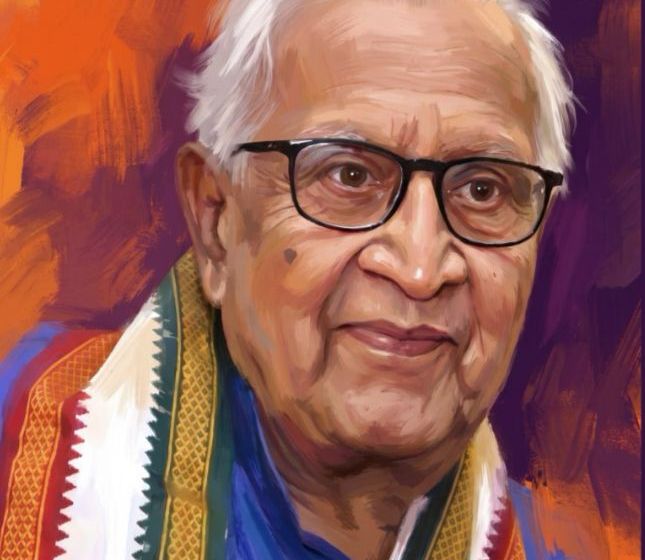
- Poet Satyanarayan was the creator of ‘Mere Bharat Ke Kanth-Haar’ and the anthem of Nalanda University.
— Murli Manohar Srivastava
The passing of Poet Satyanarayan, the author of Bihar’s state anthem, is an irreparable loss to the literary world. However, the literary masterpieces he created grant him immortality. Satyanarayan was among those distinguished creators who enriched the literary tradition of Bihar. Rather than viewing literature merely as a medium of aesthetic appeal, he belonged to that significant tradition of modern poets who tied literature directly to society, public life, and the pulse of the times. He gained distinct recognition as the creator of the Bihar State Anthem—“Mere Bharat Ke Kanth-Haar, Tujhko Shat-Shat Vandan Bihar”—which gave voice to the identity and pride of Bihar.
Poet Satyanarayan’s popularity soared after penning the Bihar State Anthem: “Mere Bharat Ke Kanth-Haar, Tujhko Shat-Shat Vandan Bihar.” The anthem gives voice to history, cultural heritage, pride, and belonging. It is not merely the praise of a state, but a creative document reflecting Bihar’s historical consciousness and cultural identity. The creation of the state anthem brought Satyanarayan into every household across Bihar. His identity was no longer confined to literary circles; he became the representative poet of Bihar’s cultural ethos.
Born on September 13, 1935, in Kolodihari village of Sahar block in Bhojpur district, Poet Satyanarayan spent his childhood in a rural environment. Consequently, village life, open fields, the struggles of the common person, social inequality, and the restlessness of changing times became the core subjects of his later writings. He subsequently enrolled in Patna Collegiate School for his further education. Recounting an incident, he once shared that he first had the opportunity to participate in a poetry recitation competition in 1942, where he won an award for reciting verses from ‘Jayadratha Vadh’. This marked the beginning of his uninterrupted, lifelong literary journey.
Satyanarayan belonged to an era of poetry where Chhayavaad (Romanticism), progressive consciousness, Prayogvaad (Experimentalism), and Navgeet (New Song movement) were establishing their identities. Amidst all these literary experiments, he forged a new stream by merging the traditional sensibility of songs with modern social and political realism. By the 1960s, his writings began appearing in prominent magazines and newspapers. As his poetic spirit took flight, the struggles of the common man, the ironies of democracy, and social inequalities became vividly visible in his work. Although writing primarily in Hindi, being born of the Bhojpuri soil, he accorded equal importance to both Hindi and Bhojpuri throughout his literary journey.
I was once sitting at his Kadamkuan residence when he reminisced about the 1974 JP Movement. He shared that under the leadership of Phanishwar Nath ‘Renu’, he had the opportunity to recite poetry at designated public squares and crossroads. This street-level recitation enabled direct dialogue with the public, sharpening the edge of his writing. For this reason, he was also hailed as the ‘Poet of the JP Movement’ and a ‘Street Poet’ (Nukkad Kavi). A defining quality of his poetry was that while remaining deeply literary, it transformed into a language of mass communication. In his writing, alongside imagination and aesthetic beauty, he addressed the anguish of the masses, political deception, social injustice, and structural weaknesses in democratic governance. He never treated poetry as mere entertainment; instead, he used it as an instrument of social dialogue.
Satyanarayan’s contribution is regarded as pivotal to the evolution of Hindi Navgeet. His songs carry the rhythm and sensibility of traditional poetry while engaging with thoroughly modern subjects. They express the realities of a changing society, political tensions, economic disparity, moral crises, and the inner turmoil of the common individual. This enabled his poetry to act as an enduring bridge between the reader and the listener.
Satyanarayan wrote across multiple genres, including poetry, Navgeet, and memoirs. His prominent works include:
- Tum Na Nahi Kar Sakte (Poetry Collection)
- Tootte Jal-Bimb (Navgeet Collection)
- Sabhādhyaksh Hans Raha Hai (Navgeet / Poetry Collection)
- Sunein Prajājan (Song / Navgeet Collection)
- Smritiyon Mein (Memoir)
He also edited poetry collections like Dharti Se Judkar and literary magazines such as Nukkad Kavita.
Conferred with prestigious honors such as the Bihar Rashtrabhasha Parishad’s Distinguished Literary Service Award, Raman Sahitya Puraskar, Gopal Singh Nepali Puraskar, Bharatendu Harishchandra Puraskar, and Nagarjun Samman, Poet Satyanarayan often remarked: “A poet’s poem should speak louder than the poet himself.” It is precisely this vision that made him a revered household name across Bihar through the state anthem.
The simplicity of folk life, the anxiety of modern existence, sharp identification of social anomalies, political consciousness, lyrical cadence, evocative imagery, and profound empathy for the common man remain the hallmarks of his verses. Ultimately, “Mere Bharat Ke Kanth-Haar, Tujhko Shat-Shat Vandan Bihar” gave him a permanent voice in the cultural consciousness of Bihar.